
Mushroom Coffee: What Is It, and Is It Actually Good for You?
Mushroom coffee is an instant drink that blends coffee or cocoa with powdered extracts of mushrooms such as lion's mane, cordyceps and chaga, usually with less caffeine than a normal mug. Whether it is good for you is not settled: the trials on its ingredients are small, none tested a mushroom coffee, and no health claim for these mushrooms is authorised in Great Britain.

What is mushroom coffee?
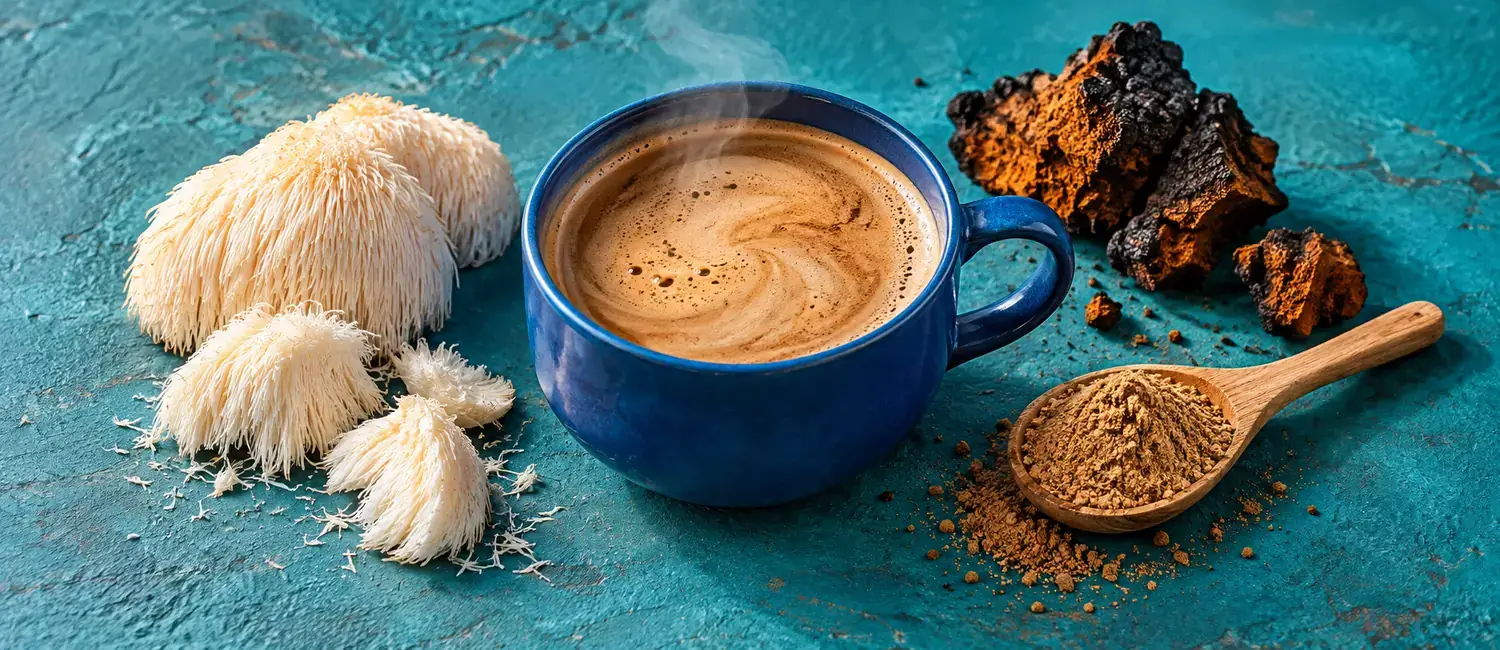
Mushroom coffee is a powdered drink that blends instant coffee, or sometimes cocoa, with dried extracts of edible mushrooms such as lion's mane, cordyceps, chaga or reishi, and you make it like instant coffee by stirring a spoonful into hot water or milk, usually for less caffeine than a standard mug.
These are not supermarket button mushrooms but species sold as "functional" mushrooms, extracted and ground into a fine powder. Many brands also add plants such as maca, ashwagandha or rhodiola, vitamins, fibre or a sweetener.
Two families sit under the same name. Some are real coffees with mushrooms added, such as Myracle, whose cup is instant Arabica with 40 mg of caffeine (see our Myracle mushroom coffee review). Others are cocoa drinks with little or no coffee, such as Clearly Not Coffee (8 mg of caffeine in the Original). Both are sold as mushroom coffee, so read the label.
What is actually in the cup: extracts, fruiting bodies and mycelium
Three details on a label say more than the word "mushroom": the form, the part of the mushroom used and the dose per cup.
- Extract or powder. An extract is concentrated. A ratio such as 8:1 means roughly eight parts of dried mushroom went into one part of extract: Variety Mode, for example, describes the mushrooms in Gold Dust as 8:1 fruiting body extracts. A plain powder is simply the dried mushroom, ground.
- Fruiting body or mycelium. The fruiting body is the mushroom you can see. Mycelium is the root-like network, often grown on grain, and some of that grain can end up in the powder.
- Milligrams per cup. Some brands give a figure for each mushroom; others print only a total, or a "blend" with no number at all.
Why the mycelium question matters: a 2016 method paper from the Irish laboratory Megazyme (McCleary and Draga) showed how beta-glucan, a structural carbohydrate of mushroom cell walls, can be measured separately from starch in mushroom and mycelium products. Mycelium grown on oats or rice can carry some of that starch into the powder, so a brand that says fruiting body, or prints a beta-glucan percentage, gives you something you can check. Our guide to lion's mane coffee and the milligrams in each cup goes further on ratios.
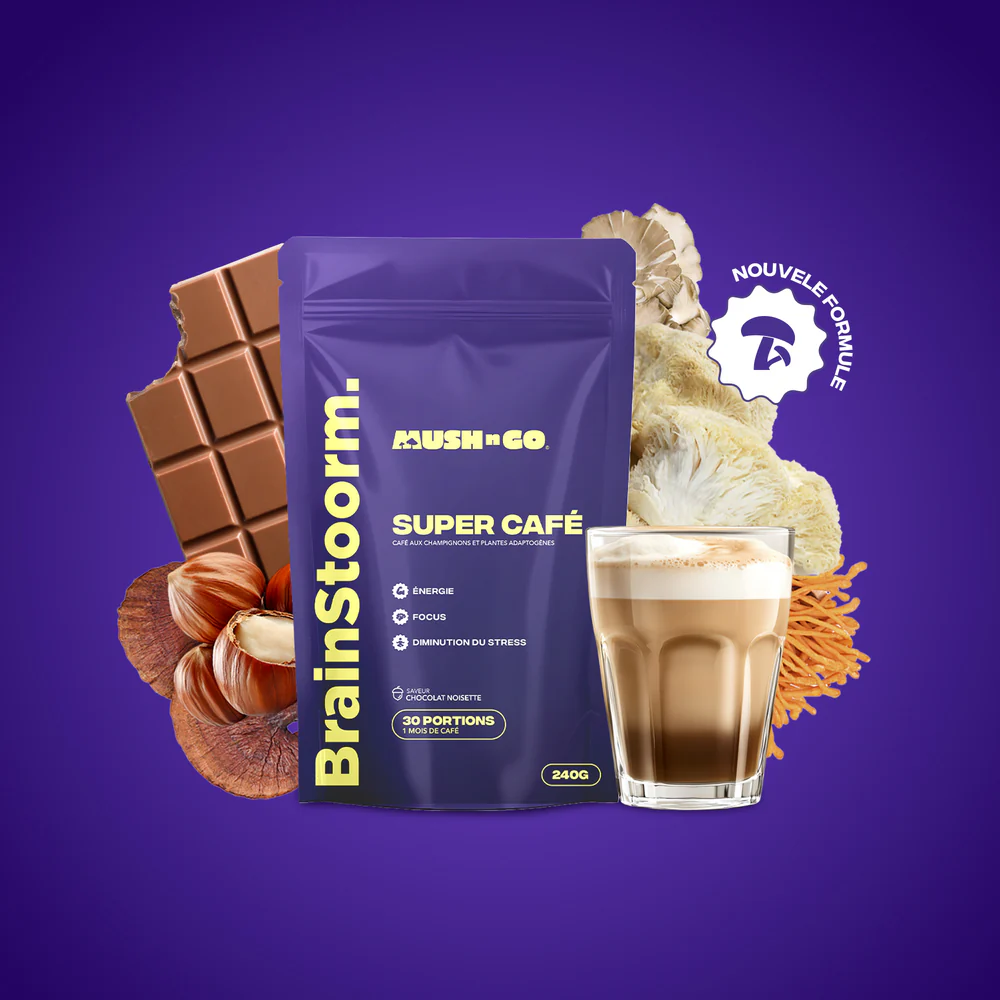
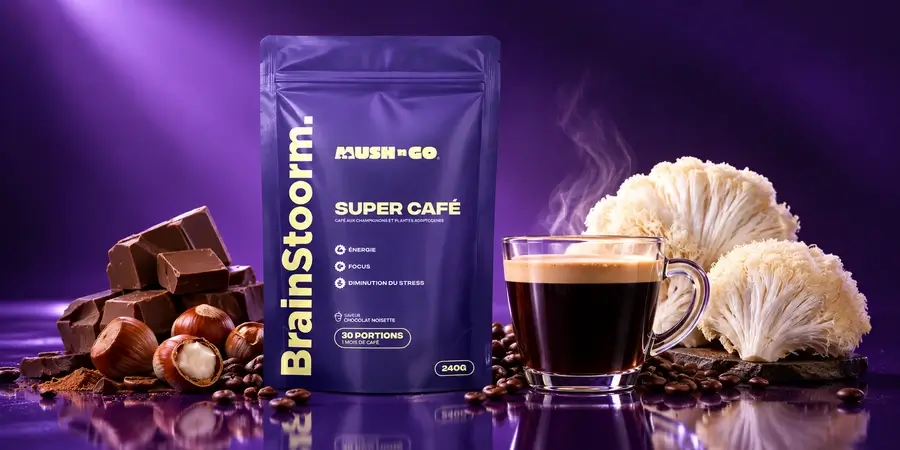
A full label looks like this. Brainstoorm by Mush N Go, No. 1 in our UK top 5 of mushroom coffees, lists per 8 g cup of its Chocolate version: lion's mane, cordyceps and chaga at 1,000 mg each (fruiting bodies only, according to the brand), maca 3,000 mg, acacia fibre 2,708 mg, cacao 1,400 mg, ashwagandha 200 mg and rhodiola 25 mg. That makes 6,225 mg of declared actives per cup, the most complete formula in our top 5, with 20 mg of caffeine. It is also the only formula in our top 5 that declares a dose of added fibre.

Which mushrooms are used: lion's mane, cordyceps, chaga and reishi
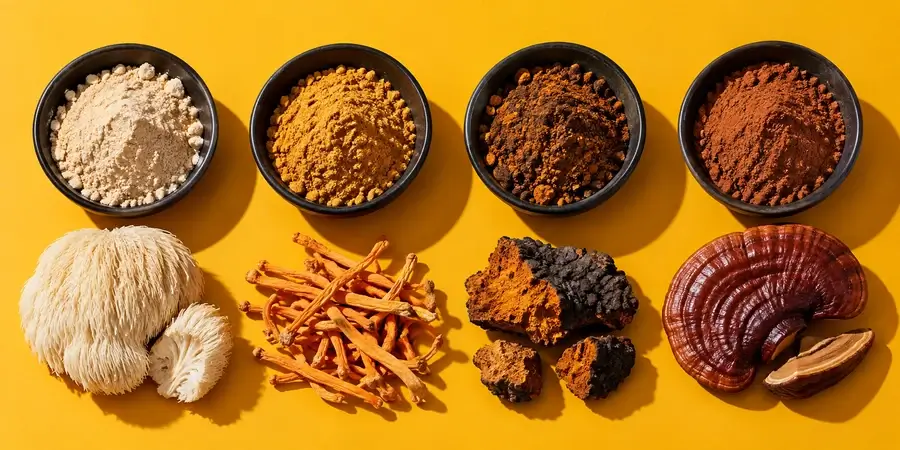
Four species turn up in almost every UK blend. Here is what each one is, without the promises.
- Lion's mane (Hericium erinaceus): a white, shaggy mushroom that is also eaten fresh in parts of Asia. A 2015 review by Friedman catalogues its compounds, including hericenones and erinacines. The UK blends we compare contain from 250 mg (London Nootropics Flow) to 1,000 mg per cup.
- Cordyceps: two species are sold, Cordyceps sinensis and Cordyceps militaris. They are not the same thing, and labels do not always say which one is inside.
- Chaga (Inonotus obliquus): a hard, dark growth found on birch trees. It is very rich in oxalates, and a Japanese case report from 2014 describes kidney damage in a 72-year-old woman who had taken 4 to 5 teaspoons of chaga powder a day for six months.
- Reishi (Ganoderma lucidum): a bitter, woody mushroom used almost only as an extract. It is in Clearly Not Coffee, Myracle and Variety Mode's Gold Dust. Brainstoorm contains no reishi.
Other names appear too: maitake in Clearly, tremella and agaricus blazei in Myracle. More species on a label does not mean more of each. Myracle's six mushrooms add up to 2,100 mg per cup, against 3,000 mg for Brainstoorm's three and 4,000 mg for the four in Gold Dust, which has the most mushrooms per cup in our top 5.
What does mushroom coffee taste like?
We compare labels and prices, so we will not describe a taste as if it were our own. Here is what decides it, and how the brands describe theirs.
The base does most of the work. A blend built on instant Arabica, such as Myracle (with coconut milk and MCT oil) or Spacegoods Rainbow Dust Coffee, starts from the taste of instant coffee. A cocoa base gives a chocolate drink: Clearly sells its Original lightly sweetened and also offers an Unsweetened version, while Mush N Go describes Brainstoorm Chocolate as choc-hazelnut. The mushroom extracts weigh a few grams at most, and every brand leans on the coffee or cocoa in its description.
Sweeteners change the result too. Brainstoorm uses xylitol, Gold Dust erythritol and Clearly Original a stevia-derived sweetener (Reb M), while Myracle suggests adding milk or a sweetener to taste. A trial pack is the cheapest way to find out: Spacegoods sells 7 servings for £14.00 (its other offers are on our Spacegoods discount code page) and Myracle 7 sachets for £6.99.
How much caffeine is in mushroom coffee?
Anything from almost none to as much as a strong mug of coffee. Caffeine in UK mushroom coffees runs from 4 mg (Clearly Decaf) to 120 mg (the top of the range Spacegoods gives for its Coffee flavour), so the brand matters more than the category. For comparison, the NHS puts a mug of instant coffee at about 100 mg and a mug of tea at about 75 mg.
| Drink | Base | Caffeine per cup | Price per cup |
|---|---|---|---|
| Clearly Not Coffee Original | Cocoa | 8 mg | £1.00 |
| Brainstoorm Chocolate (Mush N Go) | Cocoa, choc-hazelnut | 20 mg | £1.27 |
| Myracle Mushroom Coffee | Instant Arabica | 40 mg | £1.00 |
| Gold Dust Cocoa (Variety Mode) | Cocoa | 50 mg (added) | £1.33 |
| London Nootropics (Flow, Zen, Mojo) | Instant coffee | 80 to 110 mg | £0.83 to £1.25 |
| Spacegoods Rainbow Dust Coffee | Coffee | 80 to 120 mg | £1.63 |
| Mug of instant coffee (NHS figure) | Coffee | About 100 mg | Varies |
Brand figures and one-off prices read on the brands' UK shops on 29 September 2026; London Nootropics price per sachet depends on pack size. NHS figure from its pregnancy guidance (page reviewed 15 June 2026).
Check the version too: Clearly also sells a Coffee flavour at 45 mg, and Spacegoods a Decaf Coffee at under 10 mg. To compare mushroom coffee with chicory, tea or cacao, our guide to coffee alternatives and their caffeine per cup puts them side by side.
Is mushroom coffee good for you? What the research does and does not show
No published trial has tested a mushroom coffee as sold in the UK. The research is on single ingredients, in small groups, often at doses higher than a cup provides. Here is what the main human trials measured.
- Mori, 2009 (Japan): 30 people aged 50 to 80 with mild cognitive impairment, 15 per group, took about 3 g a day of lion's mane powder in tablets for 16 weeks. Scores on a cognitive scale were better than with placebo at weeks 8, 12 and 16, then fell back within four weeks of stopping. A small trial in older adults, using powder rather than an extract.
- Docherty, 2023 (Northumbria University): 41 healthy adults aged 18 to 45 took 1.8 g of lion's mane a day for 28 days. One task was completed faster 60 minutes after a dose; other results were null and a few were negative. The authors ask for caution given the small sample.
- Surendran, 2025: 18 young adults, a single 3 g dose of a 10:1 lion's mane extract. No significant effect on overall cognition or mood scores at 90 minutes; one test out of many improved. Two of the authors worked for a drinks company that uses lion's mane in its products.
- Hirsch, 2017 (United States): 28 young adults took 4 g a day of a mushroom blend containing Cordyceps militaris. Nothing changed after one week; VO2max rose after three weeks in the 10 volunteers who carried on. A blend, a small group, and the militaris species rather than sinensis.
Put next to a cup, the gap is plain: the lion's mane trials used 1.8 g to 3 g a day, while the UK blends we compare provide 250 mg to 1,000 mg per cup. So the honest answer is that nobody knows for mushroom coffee as such. What you can judge is the caffeine, the sugar, the price and the other ingredients.
Why no health claims are allowed on mushroom coffee in the UK
In Great Britain, a food can only carry a health claim that is listed as authorised on the Great Britain nutrition and health claims register, kept by the Department of Health and Social Care. The register lists claims submitted for cordyceps sinensis, reishi, maitake, shiitake and rhodiola as not authorised, and it holds no authorised claim at all for lion's mane, chaga or ashwagandha. Northern Ireland follows the EU rules instead.
Advertising follows the same line. Section 15 of the CAP Code, applied by the Advertising Standards Authority, only allows health claims that are authorised on the applicable register, or claims with the same meaning, and a general "good for you" message is only acceptable when an authorised claim sits next to it.
That is why the claims you do see on some packs come from vitamins, not mushrooms. Pantothenic acid (vitamin B5), added to several blends, has an authorised claim about tiredness and fatigue that can only be used when the product contains enough of it. Ashwagandha is also under review: the Food Standards Agency ran a call for evidence in 2024, published a summary in June 2026 and passed the responses to the Committee on Toxicity, with no final opinion published by 29 September 2026. We follow the same rules here: doses and caffeine, not promises.
Is mushroom coffee a scam? The honest pros and cons
Not in the sense of a product that is not what it says: the brands we compare print milligrams for each mushroom. The weak points are marketing that runs ahead of the evidence, some blends with tiny or undisclosed doses, and the price.
What speaks for it
- Less caffeine than coffee in many blends: 8 mg to 40 mg a cup in three of our top 5.
- Labels you can read: several brands give milligrams per mushroom and say fruiting body.
- Money-back guarantees of 30 to 60 days, so you can try the habit at little risk.
What speaks against it
- No trial on the drink itself, and ingredient trials at doses higher than a cup.
- The price: £1.00 to £1.63 a cup across our top 5.
- Ingredients that do not suit everyone: ashwagandha, chaga, reishi and caffeine. Our page on lion's mane side effects and who should avoid it goes through each of them.
Our view: treat it as a lower-caffeine drink with a full label, not as a supplement that will change how you feel, and choose on the label rather than the marketing.
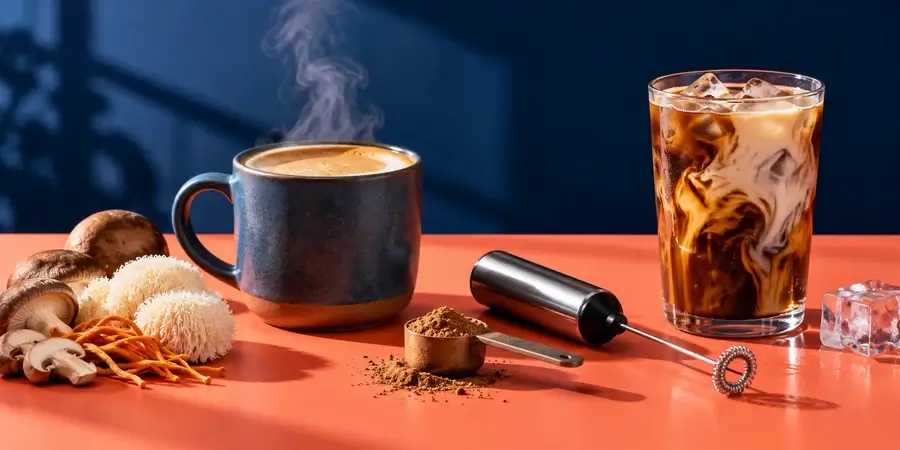
How to choose and make mushroom coffee
Five checks before you buy:
- Milligrams per mushroom, not just the name of a blend.
- Fruiting body or mycelium, and the extract ratio if one is given.
- Caffeine per cup, especially if you are pregnant, breastfeeding or sensitive to it.
- Price per cup: divide the price by the number of servings, not by grams.
- Guarantee and subscription terms: some free samples turn into a subscription, so read the checkout page.
Making it is simple. The brands we compare say one scoop of 6 g to 8 g stirred into hot water or milk (Myracle suggests 200 ml to 250 ml); Myracle and Variety Mode say hot or cold water both work. Stick to the serving on the pack: Myracle suggests one to two cups a day, and Spacegoods' help centre one to two servings.
We rank five brands on dose, label, caffeine, price per cup and guarantee in our comparison of the best mushroom coffee in the UK. If you would rather have a cocoa drink later in the day, our guide to mushroom hot chocolate in the UK compares the cacao blends. The links to shops on this site are affiliate links, and our top 5 only lists partner brands.
Mushroom coffee: frequently asked questions
Is mushroom coffee really good for you?
Nobody can say yet. No trial has tested a mushroom coffee as sold, and the trials on lion's mane or cordyceps are small, short and used higher doses than a cup provides, such as 1.8 g to 3 g of lion's mane a day. What is certain is that many blends contain less caffeine than coffee. No health claim for these mushrooms is authorised in Great Britain.
Why do I feel weird after drinking mushroom coffee?
No study has looked at this, so there is no proven answer. A new blend changes several things at once: your caffeine dose, new plant extracts, and often a sweetener, fibre or MCT oil. Dropping from a 100 mg coffee to a 20 mg cup can itself bring withdrawal headaches and tiredness for a few days. If a drink does not agree with you, stop it and ask a pharmacist.
What is the downside to mushroom coffee?
The price is the clearest one: £1.00 to £1.63 a cup in our top 5. The evidence on the mushrooms is thin, some ingredients do not suit everyone (chaga is very high in oxalates, ashwagandha is under review by the Food Standards Agency) and some blends contain as much caffeine as ordinary coffee. Read the label before you assume it is milder.
Is it safe to drink mushroom coffee every day?
The brands design their blends for daily use and suggest one or two cups, but there is no long-term safety data on mushroom coffee itself. Keep to the serving on the pack, count its caffeine in your daily total, and speak to your GP or pharmacist first if you are pregnant, breastfeeding, take regular medicines or have kidney or liver problems.
Sources
- McCleary BV, Draga A (2016). Measurement of β-Glucan in Mushrooms and Mycelial Products. Journal of AOAC International. PubMed 26957216
- Mori K, Inatomi S, Ouchi K et al. (2009). Improving effects of the mushroom Yamabushitake (Hericium erinaceus) on mild cognitive impairment: a double-blind placebo-controlled clinical trial. Phytotherapy research : PTR. PubMed 18844328
- Docherty S, Doughty FL, Smith EF (2023). The Acute and Chronic Effects of Lion's Mane Mushroom Supplementation on Cognitive Function, Stress and Mood in Young Adults: A Double-Blind, Parallel Groups, Pilot Study. Nutrients. PubMed 38004235
- Surendran G, Saye J, Binti Mohd Jalil S et al. (2025). Acute effects of a standardised extract of Hericium erinaceus (Lion's Mane mushroom) on cognition and mood in healthy younger adults: a double-blind randomised placebo-controlled study. Frontiers in nutrition. PubMed 40276537
- Hirsch KR, Smith-Ryan AE, Roelofs EJ et al. (2017). Cordyceps militaris Improves Tolerance to High-Intensity Exercise After Acute and Chronic Supplementation. Journal of dietary supplements. PubMed 27408987
- Friedman M (2015). Chemistry, Nutrition, and Health-Promoting Properties of Hericium erinaceus (Lion's Mane) Mushroom Fruiting Bodies and Mycelia and Their Bioactive Compounds. Journal of agricultural and food chemistry. PubMed 26244378
- Kikuchi Y, Seta K, Ogawa Y et al. (2014). Chaga mushroom-induced oxalate nephropathy. Clinical nephrology. PubMed 23149251
- Juliano LM, Griffiths RR (2004). A critical review of caffeine withdrawal: empirical validation of symptoms and signs, incidence, severity, and associated features. Psychopharmacology. PubMed 15448977
- NHS (2026). Foods to avoid in pregnancy (caffeine and herbal teas). nhs.uk (page last reviewed 15 June 2026, read on 29 September 2026). NHS
- Department of Health and Social Care (2026). Great Britain nutrition and health claims (NHC) register. Department of Health and Social Care, gov.uk (last updated 19 May 2026, read on 29 September 2026). GOV.UK
- Committee of Advertising Practice (2026). CAP Code, section 15: Food, food supplements and associated health or nutrition claims. asa.org.uk (read on 29 September 2026). ASA / CAP
- Food Standards Agency (2026). Summary of responses to call for evidence on Ashwagandha. Food Standards Agency, gov.uk (published 25 June 2026, read on 29 September 2026). FSA
This information is general and does not replace advice from your GP, midwife, pharmacist or a registered dietitian. The studies describe the state of research and are not authorised health claims for any product.

Read next
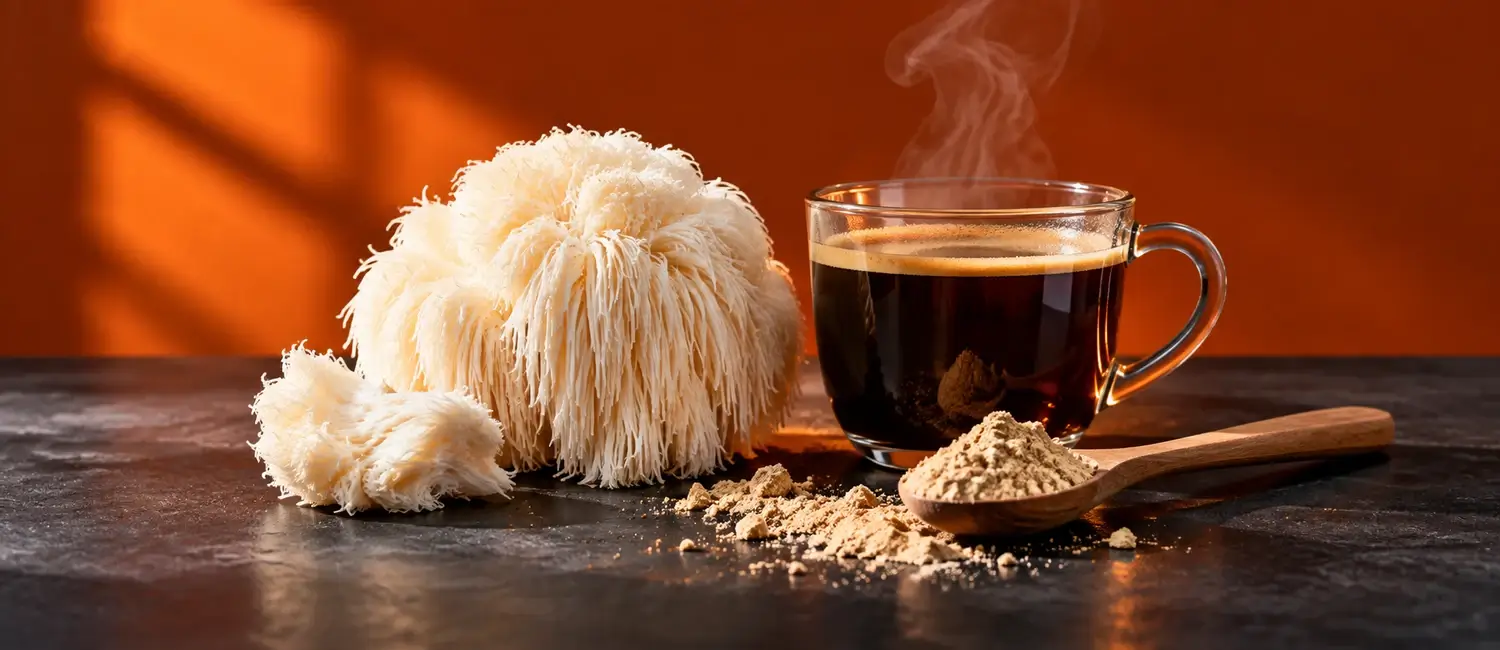
Lion's Mane Coffee UK: How Much Is Really in Your Cup?
How many milligrams of lion's mane each brand puts in a cup, extract or powder, and the price per cup in pounds.
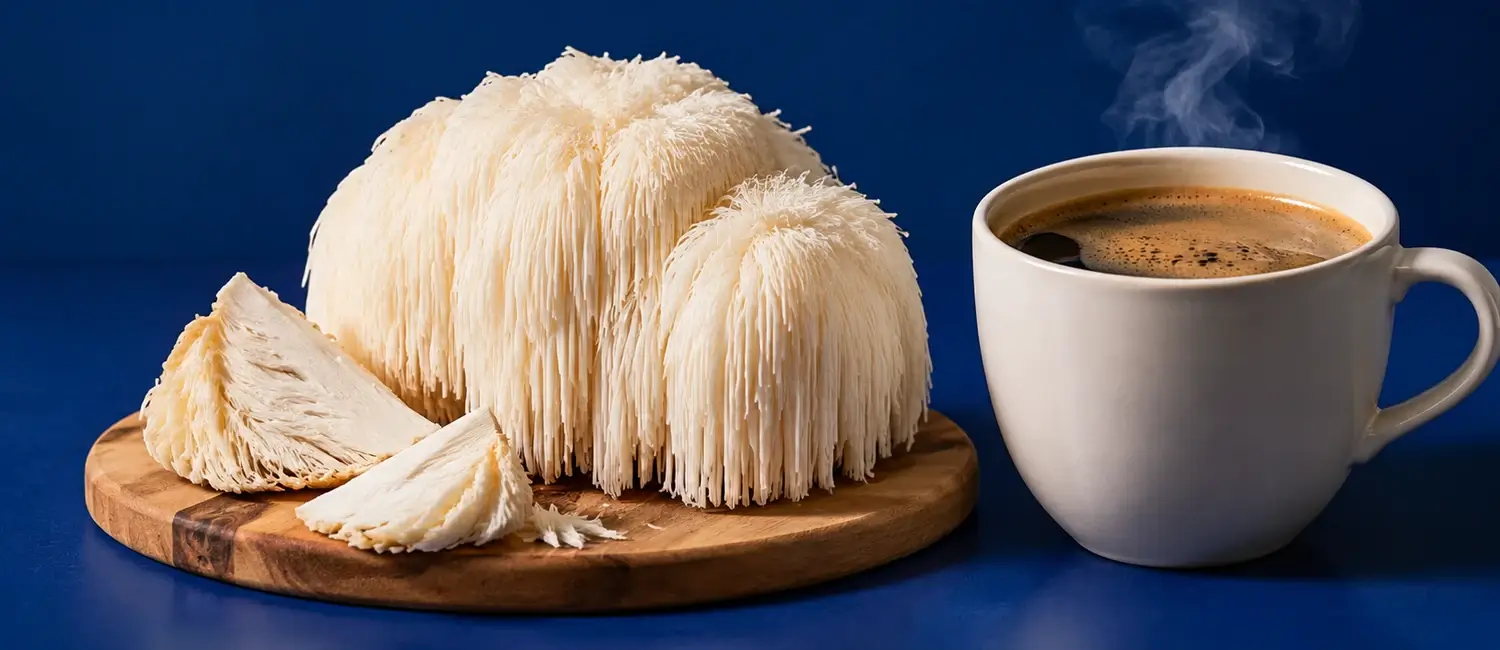
Lion's Mane Side Effects: Who Should Avoid It, and Why
What studies and case reports show, who should avoid lion's mane, and what it means for your mushroom coffee.
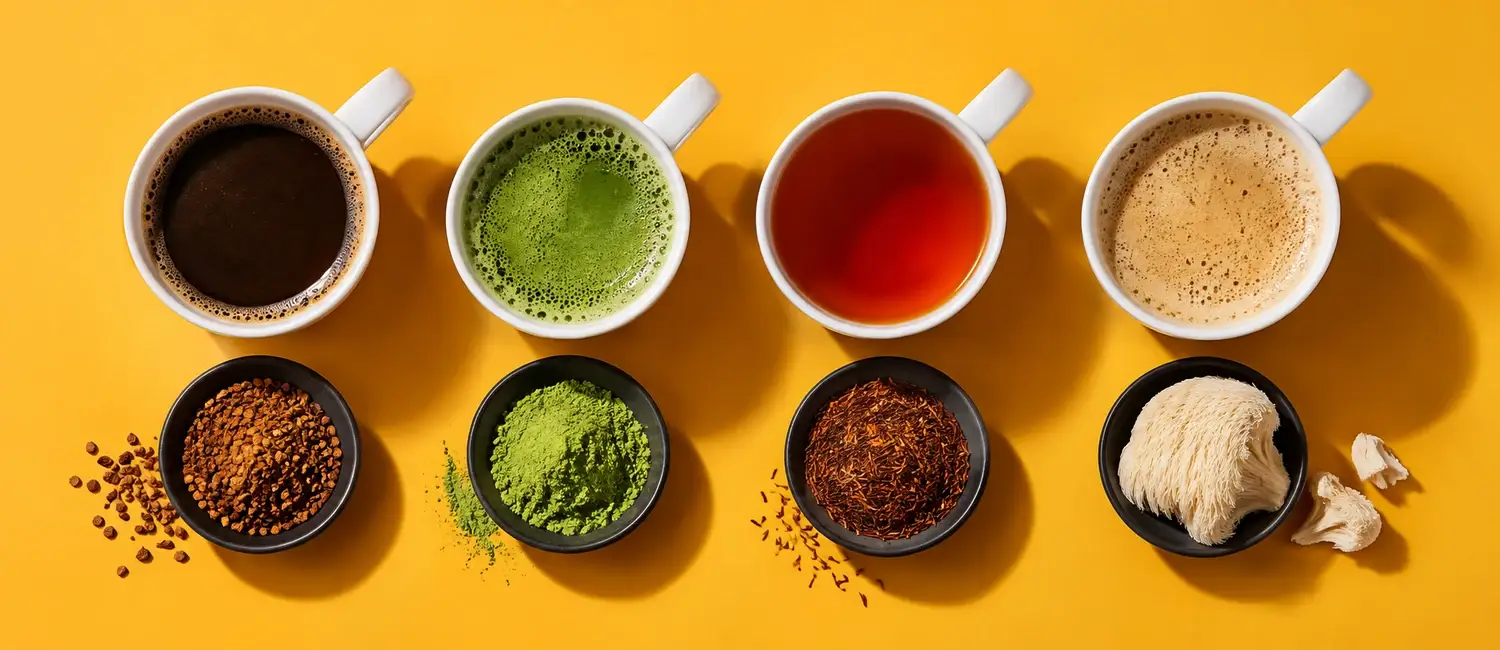
Coffee Alternatives UK: Caffeine, Taste and Price per Cup
Mushroom coffee, chicory, dandelion, barley, matcha, rooibos and cacao compared on caffeine, taste and price per cup.